Andrew Kirby: Storytelling
Thirst, Best and the Stories We Tell About Drinking
John Robins’ Thirst made me think about George Best, the stories we tell ourselves about drinking, and a forthcoming trip to Belfast with my dad.
I loved Thirst by John Robins. I also found parts of it extremely uncomfortable. Not because Robins’s drinking seemed alien to me, but because some of it didn’t seem alien enough.
I drink too much. I know I do. There. That’s an uncomfortable sentence to write. And one of the remarkable things about Thirst is the number of uncomfortable sentences Robins is prepared to write. Not simply about the amount he drank, or the consequences of drinking, but about the elaborate architecture we can construct around alcohol: the rules, the bargains, the exceptions, the justifications.
Most of all, the stories. Because drink comes with stories. I’ve had a hard week; it’s Friday; we’re out; I’m on holiday; it’s a special occasion; it’s only a couple. And sometimes the story is simply that this is what we do.
Robins writes about all of this with extraordinary candour and, importantly, humour. Thirst is frequently very funny. Perhaps it has to be. But the laughter has an increasingly uncomfortable echo when you recognise some of the mechanisms he describes.
I did. That doesn’t mean my story is Robins’s story. It certainly doesn’t qualify me to diagnose myself, or anybody else. But there were moments when I recognised the little negotiations, the shifting parameters, the ability to produce a perfectly reasonable explanation for something you already know probably isn’t particularly reasonable.
Recognition is one of the things great writing can do. Sometimes you open a book and find somebody else has written down something you’d prefer not to have recognised.
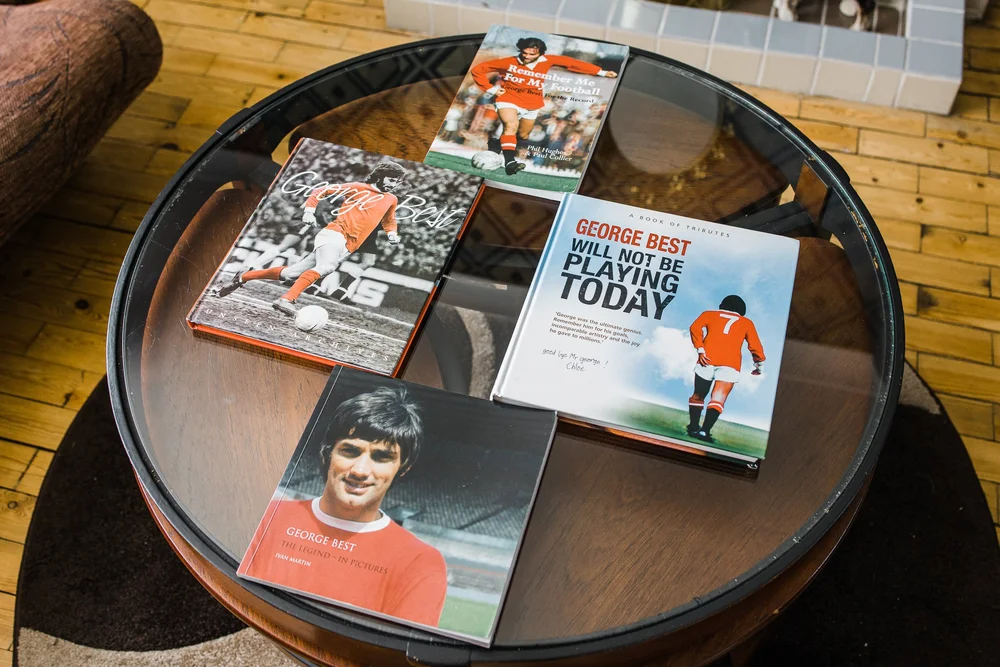
And Thirst got me thinking about George Best. I’ve been thinking about George a lot anyway. My next football book, Seven: Manchester United’s Iconic Shirt, is published by Pitch Publishing in January. Of all the players I wrote about for the book, Best presented perhaps the greatest problem — not because there wasn’t enough material, but because there was far too much.
I cut more from his chapter than from anybody else’s and some of that material is going to get another life. From 5–7 October, I’m going to Belfast with my dad. We’re going to visit George Best’s childhood home, and I want to write about the experience afterwards.
My dad is closing in on 80. He has been going to watch Manchester United for more than sixty years. He saw Best play and that matters to me. George Best isn’t simply a historical footballer to my dad, or a collection of grainy clips, biographies and extraordinary statistics. He watched him. He saw the young man from Belfast become Best.
And now father and son are going back to where another father and son once lived. To the house where George was simply George. Before the European Cup, before the Balon d’Or, before the fame and the nightclubs and the women and the newspaper headlines. Before the drinking became inseparable from the story we told about him.
That last part has been bothering me since I finished Thirst. One of the ideas that runs through Robins’s book is the fantasy of being able to go backwards. What if the sober John could somehow speak to the John who was still drinking? What if he could tell him that things would be all right? That the life on the other side of alcohol wasn’t something to fear? That perhaps he didn’t need the thing he’d convinced himself he needed?
There is something incredibly moving about that idea. Because one of the people an alcoholic might actually listen to is another alcoholic. And who could be more convincing than yourself?
Which made me wonder: Would George have listened to George? Imagine being able to send the older George Best back into that house in Belfast. Perhaps not even all the way back to childhood. Perhaps we could choose the moment.
Which George do we send him to? The teenager about to leave home for Manchester? The European Footballer of the Year? The young superstar discovering that fame could buy almost anything? The man whose drinking was becoming a problem but hadn’t become the problem yet?
Yet. There’s a word. I’ve been thinking about yet for another reason. I recently finished a different book of my own, The Buzz of Flight, which I’m planning to return to properly after Belfast. That tiny word is important to it.
Yet. Something hasn’t happened yet. Somebody hasn’t crossed the line yet. A relationship hasn’t broken yet. A drink hasn’t become the next drink yet.
A life hasn’t acquired the ending which, looking backwards, can seem horribly inevitable. Because that’s the problem with biography. We know the ending. George doesn’t.
We look at photographs of the young Best and carry knowledge into them that he couldn’t possibly possess. We can see the trajectory because we’re standing at the other end of it. The boy in Belfast is simply living forwards. There are still a million yets ahead of him.
That’s what I want to think about when I visit the house. Not simply the superstar who came afterwards. And not simply the tragedy either. The person before the story hardened around him.
We have always told stories about George Best and drinking. Some of them George told himself. Some he told journalists. Some journalists told about him. And plenty of them are very funny. That’s part of the difficulty. The drinking became incorporated into the Best mythology: champagne, casinos, nightclubs, beautiful women, outrageous one-liners. The excess became another expression of the same glorious refusal to live by ordinary rules that people saw when he had a football at his feet.
But we know where that story goes. And knowing the ending changes the joke. Perhaps that’s another reason Thirst affected me. Robins has done something courageous. He has taken control of the story he once told himself about drinking and written another version of it from the other side. Not everybody gets to do that. George didn’t.
So on 5 October I’ll get on a plane with my dad and we’ll go to Belfast. Partly I’m going because I’m writing about Manchester United. Partly because I have all that material which couldn’t fit into Seven: Manchester United's Iconic Shirt. Partly because I want to see the place where one of football’s biggest stories began.
But Thirst has given me another reason. I want to stand in George Best’s childhood home and try, however impossibly, to forget what happened next. To look for the boy rather than the legend. To think about the stories we tell about drinking, and the stories drink allows us to tell ourselves. And perhaps to think a little about my own.
I don’t know what I’ll find there. But then I haven’t been to Belfast yet.